

New Mexico: Birding the Land of Enchantment

Updated: Jul 24

New Mexico may be known for its stunning desert landscapes, ancient pueblos, and vibrant cultural heritage, but for birders, it represents something equally extraordinary: one of North America’s most diverse and rewarding birding destinations. With 500+ documented bird species and habitats ranging from Chihuahuan Desert lowlands to alpine tundra, the Land of Enchantment offers year-round opportunities that rival any state in the country.
Winter in New Mexico
While New Mexico offers excellent birding year-round, certain seasons bring spectacular concentrations and unique opportunities. Winter in particular, transforms the Rio Grande Valley into one of North America’s premier waterfowl destinations. Bosque del Apache National Wildlife Refuge hosts one of the continent’s greatest wildlife spectacles, with tens of thousands of Snow Geese, Ross’s Geese, and Sandhill Cranes gathering in the refuge’s managed wetlands. The dawn and dusk fly-outs, when thousands of birds take wing simultaneously, create an unforgettable cacophony of sight and sound that draws photographers and birders from around the world. Winter also brings excellent raptor diversity. Red-tailed Hawks are joined by Ferruginous Hawks, Rough-legged Hawks, Golden Eagles, and Prairie Falcons in open grasslands, while Northern Harriers quarter over fields and Bald Eagles congregate near reservoirs and rivers with open water.
Why This Destination Is Special for Birders
New Mexico’s exceptional birding stems from its unique geography. Situated at the intersection of four major biogeographic regions: the Rocky Mountains, Great Plains, Chihuahuan Desert, and Colorado Plateau, the state serves as a natural meeting ground for bird species from across North America. This positioning creates remarkable diversity within relatively short distances, allowing birders to encounter mountain species like Steller’s Jays alongside desert dwellers like Cactus Wrens in a single day.
Central and Northern New Mexico offer one of the most diverse winter birding experiences in the West. Within a single day, you can move from riparian wetlands full of cranes and geese to high‑elevation forests holding some of the most sought‑after species in the Rockies. Birders come here for massive winter concentrations of Sandhill Cranes, Snow Geese, and waterfowl, Rosy‑Finches (Brown‑capped, Gray‑crowned, and Black), high‑elevation specialties like American Three‑toed Woodpecker and Pine Grosbeak, desert and grassland species that reach their northern limits here, and for a landscape that changes dramatically with elevation, offering a clear, intuitive sense of how habitat shapes birdlife
Habitats That Tell a Story
New Mexico’s winter birding unfolds across a dramatic elevation gradient, and each habitat tells a different part of the story. From the Rio Grande’s fertile corridor to the quiet spruce–fir forests of the high country, the landscape shifts in clear, intuitive steps as the birdlife shifts with it.

Rio Grande Valley & Wetlands 4,000-4,800 ft
The Rio Grande is the pulse of New Mexico. Along its floodplain, managed wetlands, shallow ponds, and agricultural fields create a patchwork of open water and grain-rich foraging areas. This is prime habitat for Sandhill Cranes, Snow and Ross’s Geese, and large numbers of dabbling and diving ducks.
Desert Grasslands & Shrublands 4,800 ft-6,000 ft
Step away from the river and the land opens into broad desert grasslands and low shrublands. Look for Horned Lark, Sagebrush Sparrow, Chestnut-collared and Thick-billed Longspurs, Ferruginous Hawk, Scaled Quail, Golden Eagle, and Prairie Falcon. It’s an open, understated landscape where movement is subtle and birds often appear as shapes against sky and grass.
Foothills & Pinyon–Juniper 6,000-7,500 ft
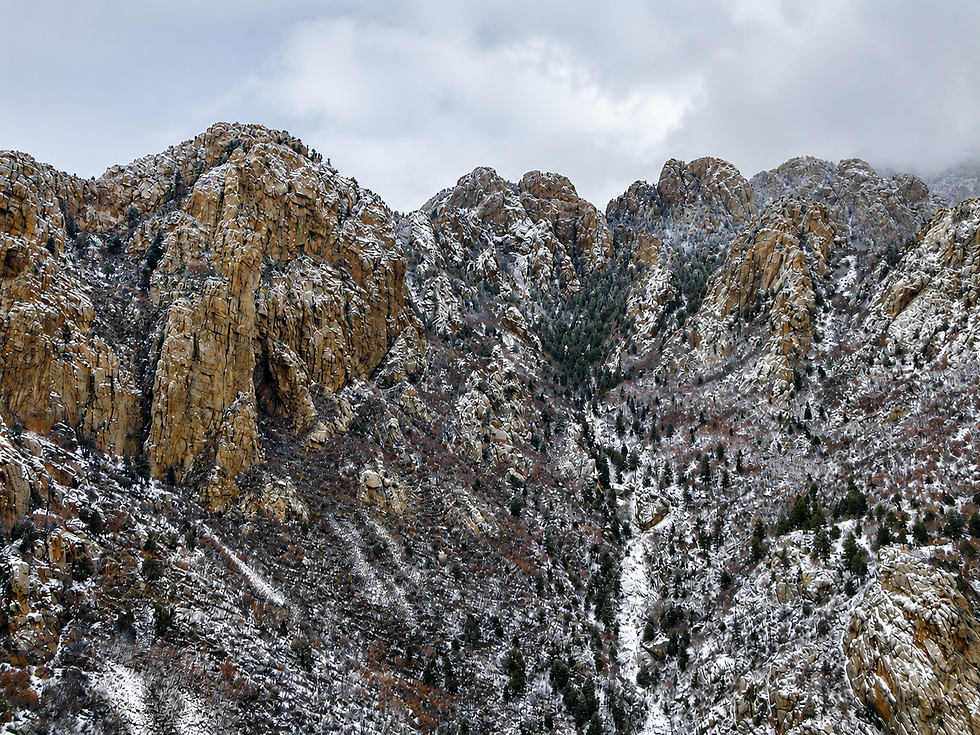
As elevation rises, the desert gives way to foothills dotted with pinyon pine, juniper, and scattered rock outcrops. The air cools, the vegetation thickens, the landscape begins to feel more vertical, and the birdlife shifts toward species adapted to this transitional zone. Expect Juniper Titmouse, Bushtit, Western and Mountain Bluebirds, Townsend’s Solitaire, Spotted Towhee, Rock Wren, and Pinyon Jay.
American Three-toed Woodpecker © Troy Hibbitts Pinyon Jay © Troy Hibbitts
Montane Forests 7,500-9,500 ft
Higher still, ponderosa pine, Douglas‑fir, and aspen stands create a mosaic of winter forest habitat. Listen for the tapping of Red‑naped Sapsuckers, and watch for Steller's Jay, Hairy Woodpecker, White-breasted Nuthatch, Evening Grosbeak, Northern Goshawk, Mountain Chickadee, and Williamson's Sapsucker.
Subalpine Spruce–Fir 9,500-11,500 ft
Dense, cool, and dark, the spruce–fir zone is one of the most distinctive winter habitats in Northern New Mexico. Snow lingers here long after it melts elsewhere, and the birdlife is specialized and often subtle. This is the best place to search for American Three‑toed Woodpecker, Pine Grosbeak, Red Crossbill, Canada Jay, and Clark’s Nutcracker. It’s a habitat where birds reveal themselves on their own terms.
High‑Elevation Ridges & Alpine Edges 11,500-13,00+ ft
Where access allows, the highest ridges and open slopes offer a glimpse into true alpine birdlife. Winter conditions can be harsh, but these exposed areas hold some of the most sought‑after species of the region. Look for rosy‑Finches, Pygmy Nuthatch, Mountain Chickadee, and Pine Siskin. This is the upper edge of New Mexico’s winter birding; stark, beautiful, and unforgettable.
Brown-capped Rosy-Finch © Troy Hibbitts Black Rosy-Finches © Greg Lasley Gray-crowned Rosy-Finch © Greg Lasley
A Living Cultural Landscape
New Mexico’s birding landscapes are inseparable from the people who have shaped, tended, and lived in for centuries. Along the Rio Grande, the winter wetlands that hold cranes and geese exist because of long‑standing agricultural traditions and acequia systems that continue to move water through the valley. These fields and canals are part of a living cultural landscape; one where farming, community, and wildlife have been intertwined for generations.
In the foothills and mountains, the story shifts again. Pinyon–juniper woodlands have supported humans for centuries, providing food, fuel, and a deep connection to place. Their seasonal rhythms, gathering practices, and long‑held traditions are still reflected in how these landscapes are used and cared for today. Higher up, the quiet spruce–fir forests and alpine edges carry their own layers of history; mining routes, old logging roads, and mountain villages tucked into the folds of the land. Everywhere you go, the human presence is subtle but enduring, woven into the terrain and the wildlife that calls it home.
Birding here means stepping into a landscape shaped by both natural forces and human hands. The cranes rising over winter fields, the rosy‑finches sweeping across high ridges, the stillness of a mountain forest; all of it exists within a broader story of stewardship, culture, and relationship to the land. To travel through New Mexico is to witness how people and place have shaped one another for centuries, and how that connection continues to sustain the habitats we explore today.

Ready to Explore New Mexico?
If New Mexico’s winter skies are calling, we’re ready to guide you through the habitats and species that make this region so special. From valley wetlands to alpine edges, we’ll help you experience the season’s most memorable moments.
Stay Connected! Be the first to know about new and upcoming tours, trip reports, photos, updates, field notes, and more.


