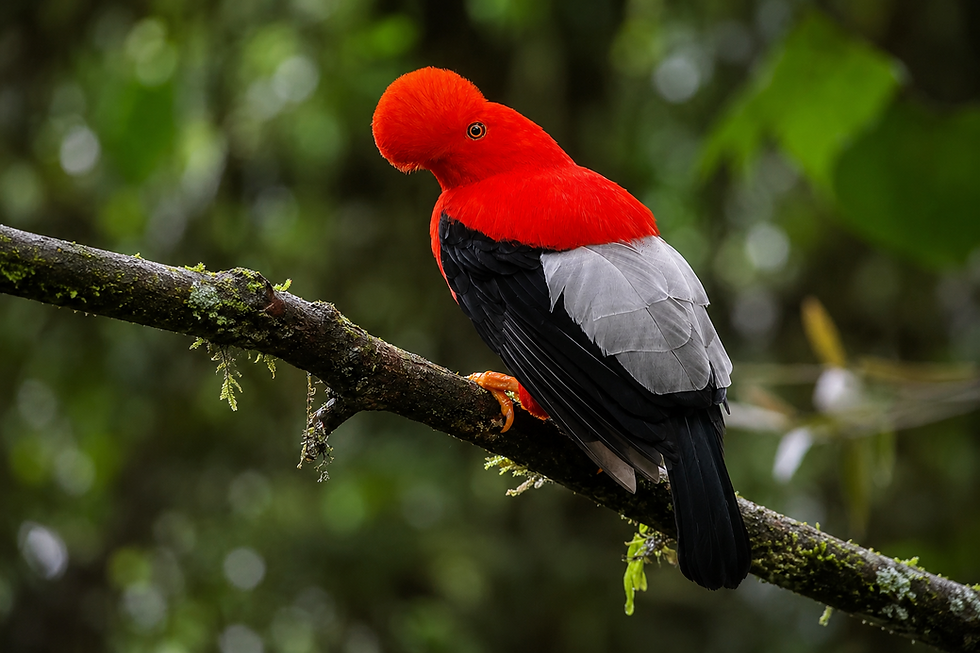
Day 1: Arrival at Quito’s Mariscal Sucre International Airport (UIO) anytime today. Quito sits at approx. 9,350 feet above sea level in a high Andean valley, cradled between volcanic ridges and steeped in colonial heritage. It holds the distinction of being the world's second-highest capital city and was among the first two cities ever designated a UNESCO World Heritage Site, a status earned by its extraordinary historic center of perfectly preserved Spanish colonial architecture, plazas, and churches. Dinner tonight is at your leisure; guests are encouraged to take it easy on the first evening, allowing the body to acclimate gently to the altitude before the active birding days ahead. Overnight: Hotel Mercure Alameda, Quito. Day 2: Zuro Loma, Alambi Reserve & Guaycapi Lodge. We depart Quito and head northwest into the Pichincha highlands, the volcanic province that cradles the capital and gives way, on its western flank, to one of the most biologically astonishing landscapes on the planet. Our first stop is Zuro Loma, a high-elevation site where páramo grades into cloud forest at a remarkable ecological frontier. From Zuro Loma, the route descends toward the legendary Tandayapa Valley and the entrance to Alambi Reserve, a lush private reserve nestled along the Alambi River. Feeders here attract a rotating cast of hummingbirds alongside tanagers, barbets, and an ever-changing parade of mixed-flock species drifting through the forest edge. The forest trails at Alambi offer some of the most productive mixed-flock birding in the region, with antbirds, woodcreepers, and foliage-gleaners. We then continue to our home base for the next five nights, the Guaycapi Birding Lodge, perched above the Guaycapi River in the heart of the Tandayapa Valley. This lodge was designed and built specifically for birdwatching, and every detail reflects that singular focus; from the balconied cottages overlooking the forested valley to the restaurant, whose wraparound feeders and tanager platforms transform every meal into a birding experience. The afternoon is spent exploring Guaycapi and the adjacent trail network as the valley light shifts from afternoon gold to the deep green of dusk, with the feeders alive with activity until the last light fades. Overnight: Guaycapi Birding Lodge. Notable species for the day include Plate-billed Mountain-Toucan, Sword-billed Hummingbird, Blue-capped Tanager, Green-tailed Trainbearer, Andean Guan, Red-crested Cotinga, Mountain Velvetbreast, Blue-winged Mountain Tanager, Golden-headed Quetzal, Chestnut-naped Antpitta, White-capped Dipper, Scarlet-bellied Mountain Tanager, Shining Sunbeam, Masked Flowerpiercer, Sapphire-vented Puffleg, Tyrian Metaltail, Spectacled Redstart, Equatorial Antpitta, Barred Fruiteater, and Golden-crowned Tanager, among many others. Day 3: Sendero Frutti Tour & Milpe Bird Sanctuary. Today we descend below the cloud forest belt into the foothill forests of the western Andes, where the Chocó bioregion begins to assert its extraordinary influence on bird life with an entirely new cast of species. Our first destination is Sendero Frutti Tour, a private birding location where thoughtfully managed fruit feeders and native plantings have created a visually stunning photography site in the Mindo region. The property attracts an extraordinary diversity of tanagers, honeycreepers, and woodpeckers, many of which would be almost impossible to observe at close range without such exceptional habitat management. In the afternoon, we continue to Milpe Bird Sanctuary, a private reserve protecting a precious remnant of foothill forest with a remarkable tally of more than 500 recorded species. Milpe's network of shaded trails leads through undergrowth where diverse species of birds bustle through leaf litter and fallen branches, while overhead, toucans, aracaris, and manakins animate the forest canopy with movement and sound. The sanctuary's hummingbird garden and feeding stations provide sustained, close-range views of species that would otherwise require hours of patient forest stalking. Andean Emerald, Green Thorntail, Crowned Woodnymph, White-whiskered Hermit, Green-crowned Brilliant, Purple-bibbed Whitetip, Speckled Hummingbird, and White-necked Jacobin are among the species that perform reliably here. Guests return to the lodge as the cloud forest settles into its evening chorus, with species lists that have grown considerably longer since breakfast. Overnight: Guaycapi Birding Lodge. Notable species for the day include Black-throated Mango, Great Antshrike, Little Tinamou, Red-headed Barbet, Maroon-tailed Parakeet, Red-billed Scythebill, Dusky-faced Tanager, Bronze-winged Parrot, Esmeraldas Antbird, Green Honeycreeper, Slaty Antwren, Collared Trogon, Golden-winged Manakin, Pale-mandibled Aracari, Black-cheeked Woodpecker, Wedge-billed Woodcreeper, Choco Warbler, Silver-throated Tanager, Golden-olive Woodpecker, Rufous Motmot, and Speckled Nightingale-Thrush, among others. Day 4: Umbrellabird Lek & La Victoriana. We are on the road well before dawn for the drive to the Umbrellabird Lek Reserve, where the extraordinary Long-wattled Umbrellabird gathers each morning to perform its remarkable lek display in the misty foothill forest. The male Long-wattled Umbrellabird is one of the largest passerines in the world; draped entirely in jet black plumage with an iridescent sheen, he wears a sweeping umbrella-like crest that fans forward over the bill and a pendulous wattle of black feathers that hangs from the upper chest and can stretch to nearly a foot in length. During display, this wattle is extended, inflated, and held forward as the male booms and postures for females with an intensity that feels almost primordial; part sound, part spectacle, part pure evolutionary theatricality. To stand in a forest at dawn and witness this display at close range is an experience that simply cannot be replicated. After the lek display winds down, we continue to Finca La Victoriana, a beloved and reliable site where a lek of Andean Cock-of-the-rock provides a close-range lek theater, vivid crimson males bobbing, bowing, and vocalizing from low perches as the forest resounds with their characteristic rasping calls. The surrounding forest at La Victoriana is also productive for a broad range of foothill specialties, and we search the canopy and undergrowth for hawks, wood-quail, and flycatchers before the drive back to the lodge. Overnight: Guaycapi Birding Lodge. Notable species for the day may include Club-winged Manakin, Empress Brilliant, Swallow Tanager, Wattled Guan, Cloud-forest Pygmy-Owl, Ornate Flycatcher, Masked Water-Tyrant, Dusky Chlorospingus, Golden Tanager, Orange-bellied Euphonia, Rufous-fronted Wood-Quail, Bat Falcon, Bicolored Hawk, Laughing Falcon, Pacific Hornero, Yellow-collared Chlorophonia, and Choco Brushfinch, to name a few. Day 5: Rio Silanche Bird Sanctuary & Las Cotingas. The lowland Chocó region is the tropical forest at the base of the Andean foothills, one of the most biodiverse and biologically distinctive ecosystems on the planet. This Chocó bioregion, spanning Ecuador and Colombia, is globally recognized as one of the world's premier biodiversity hotspots, distinguished by extraordinarily high levels of endemism among plants, amphibians, reptiles, and birds. Here, the forest canopy is dense and dripping, the humidity palpable, and the sheer number of species active in any given patch of habitat is almost overwhelming to the senses.Rio Silanche Bird Sanctuary protects a critical and irreplaceable patch of lowland Chocó Forest where the species diversity is genuinely staggering. The forest trails at Silanche wind through primary lowland vegetation where the target list includes some of the most coveted birds in all South America. In the afternoon we visit Las Cotingas, where cotingas, manakins, and specialty flycatchers are the primary attractions. The afternoon session here is a fitting complement to the morning's lowland immersion, with the forest edge and secondary growth offering a different set of opportunities than the primary forest interior. The day closes with an evening at Guaycapi Lodge's feeders, a perfect occasion to revisit any lingering gaps on the list and to savor the lodge's unique atmosphere. Overnight: Guaycapi Birding Lodge. Notable species for the day include Masked Trogon, Scarlet-thighed Dacnis, Rufous-winged Tanager, Velvety Manakin, Tawny-crested Tanager, Orange-fronted Barbet, Blue-tailed Trogon, Chestnut-fronted Macaw, White-tailed Trogon, Choco Black-throated Trogon, Yellow-tufted Dacnis, Scarlet-breasted Dacnis, Dusky Pigeon, Guayaquil Woodpecker, Blue-headed Parrot, White-bearded Manakin, Red-rumped Woodpecker, Scarlet-browed Tanager, Choco Tyrannulet, Purple Honeycreeper, and Cinnamon Woodpecker, among many others. Day 6: Amagusa Reserve & Sacha Guatusa. Today is a full day of birding within and around Amagusa Reserve, also known as Mashpi Amagusa, a private reserve operating within Ecuador's Chocó Andino UNESCO Biosphere Reserve and protecting cloud forest at approximately 3,900–5,200 feet, a subtly different elevation band from Guaycapi that shifts the species composition. The morning begins over the reserve's ridgelines, birding transitions to the forest trails, where mixed-species flocks drift through the canopy. In Neotropical cloud forest, these mixed flocks function as roving cooperative foraging parties, with different species occupying different positions and feeding niches within the same moving assemblage. Joining a good mixed flock and moving with it through the forest for thirty minutes can produce twenty or more species in rapid succession, an experience simultaneously exhilarating and technically demanding as birds appear and disappear in the dense vegetation. The reserve's trail network passes through distinct forest types and microclimates along its length, ensuring a continuously refreshing cast of species throughout the morning session. In the afternoon, we travel to Sacha Guatusa, a private farm and forest corridor in the Mashpi region where several Chocó lowland species reach their upper elevational limits, creating an overlap zone of unusual richness. We return to Guaycapi for dinner, sharing the day's highlights over the warmth of the lodge, tallying the day's list. Overnight: Guaycapi Birding Lodge. Target species include Rose-faced Parrot, White-tipped Sicklebill, Moss-backed Tanager, Barred Becard, Bay Wren, Cinnamon Becard, Dark-backed Wood-Quail, Zeledon’s Antbird, Indigo Flowerpiercer, Olive Finch, Black-chinned Mountain Tanager, Black-billed Peppershrike, Violet-tailed Sylph, Black Solitaire, Plain-backed Antpitta, Orange-breasted Fruiteater, Glistening-green Tanager, Golden-collared Honeycreeper, Black-tipped Cotinga, Choco Vireo, Emerald Tanager, Yellow-green Tanager, Brown-billed Scythebill, White-throated Quail-Dove, and Golden-naped Tanager. Day 7: Refugio Paz de las Aves, Bellavista Cloud Forest Reserve & Drive to Quito. We depart early and travel down the valley to Refugio Paz de las Aves, a legendary family-run reserve that has become one of the most famous birdwatching destinations in the country. The story began when local farmer Angel Paz discovered a Giant Antpitta in his property, one of the most coveted and notoriously secretive birds in the Neotropics. He realized that if he dug up worms and made a specific calling noise, these highly secretive birds would learn to associate him with food; earning the trust of these elusive birds. Here, Giant, Yellow-breasted, Ochre-breasted, Moustached and Chestnut-crowned Antpittas may approach guests within just a few feet, pausing with almost theatrical composure as cameras click and binoculars are raised in astonishment. The Andean Cock-of-the-rock lek at Paz de las Aves is equally extraordinary. Brilliant scarlet males, their heads enveloped in a rounded orange-red crest that covers the bill entirely, perform competitive courtship displays at close range, bobbing, bowing, and posturing in the dappled undergrowth as females observe with calculated reserve. In the afternoon we visit Bellavista Cloud Forest Reserve, a renowned property perched on a ridge along the historic Nono–Tandayapa road. The reserve trails plunge through primary cloud forest draped in hanging mosses, wild orchids, and bromeliads that festoon every available surface, and the elevation gradient shifts the bird community remarkably over very short distances. The group then makes the final drive into Quito, arriving in the capital as the city lights begin to come on across the valley below. Overnight: San Jose de Puembo, Quito. Other notable species found throughout the day may include Andean Cock-of-the-rock, Toucan Barbet, White-faced Nunbird, Flame-faced Tanager, Ocellated Tapaculo, Turquoise Jay, Rufous-breasted Antthrush, Powerful Woodpecker, Striped Treehunter, Collared Inca, Olivaceous Piha, Black-capped Tanager, Beryl-spangled Tanager, Crimson-mantled Woodpecker, Tawny-bellied Hermit, White-booted Racket-tail, Black-and-white Owl, Red-billed Parrot, and Green-and-black Fruiteater, to name a few. Day 8: Antisana National Park. The destination for the day is Antisana National Park. Dominated by the brooding, glacier-capped mass of Antisana Volcano, one of Ecuador's highest peaks at over 18,700 feet, the reserve encompasses an extraordinary altitudinal range from highland humid forest at its lower margins to open páramo grasslands and glacial wetlands stretching to the horizon. The first stop is the reserve's entrance zone, where patches of highland humid and elfin forest hold mixed species of striking Andean birds. From the forest, the route climbs into open páramo toward the Mirador del Cóndor. This is a reliable site for sustained, close-range views of the Andean Condor, the largest flying land bird in the world, riding effortlessly on thermals that rise off the volcanic rock. The golden blooms of Chuquiragua across the surrounding hillsides mark prime territory for the Ecuadorian Hillstar, a high-altitude endemic hummingbird of exceptional beauty, while Great Sapphirewing, Giant Hummingbird, Shining Sunbeam, Carunculated Caracara, Stout-billed Cinclodes, Streak-backed Canastero, and Tawny Antpitta are all strong targets across the open grasslands. The wetlands at Laguna La Mica round out the afternoon beautifully, drawing an impressive cast of high-altitude waterbirds including Andean Duck, Andean Teal, Yellow-billed Pintail, Andean Gull, Andean Lapwing, Silvery Grebe, and the Andean Ibis. Overnight: San Jose de Puembo, Quito. Day 9: Tour Conclusion & Departures from Quito. After breakfast at the hotel, the tour concludes. By the end of the journey, guests will have experienced a rich blend of Ecuador’s landscapes, conservation stories, and signature birdlife—an engaging and memorable exploration of one of the world’s premier birding regions. Participants may depart Quito at any time today.